


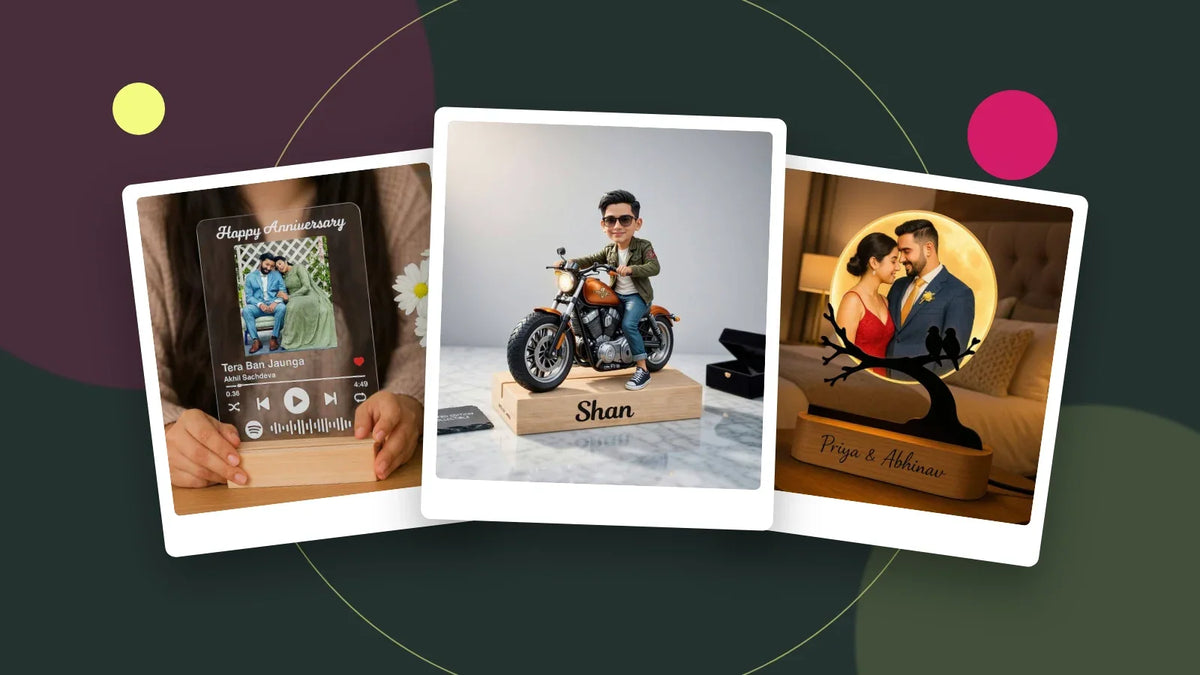
The psychology of gift giving explains why giving a gift can feel as good as receiving one. Gift giving is a way to say what words often cannot: I know you, I value you, I remember. The significance of gift giving lies less in the object and more in the message it carries, and that message is the real gift giving meaning. Below, we look at what research says about why we give, where givers go wrong and how to choose a gift that lands.
Key takeaways
- We give gifts to build bonds, show love and gratitude, keep traditions and, often, simply because giving feels good.
- Giving activates the brain's reward pathways, a feeling researchers call the warm glow.
- Receivers care far less about price than givers think; thought, effort and usefulness matter more.
- Sentimental gifts are wanted more often than givers dare to give them.
- The best gift says one clear thing: I know you, I remember us, I honour this moment, or let's share this.
Why Do We Give Gifts? The Significance of Gift Giving in 10 Reasons
People rarely give for just one reason. Psychologists and anthropologists point to a mix of motives, some generous, some social and some quietly self-interested. Here are the ten that come up again and again.

1. To build and keep bonds
In his 1925 essay The Gift, anthropologist Marcel Mauss described gift exchange as a cycle of three duties: to give, to receive and to give back. Each turn of that cycle keeps a relationship moving. A gift says the connection matters and invites the other person to stay close, which is why gifts often mark the start of friendships, partnerships and families.
2. To express love and affection
A gift turns a feeling into something you can hold. For many people, receiving a thoughtful present is one of the clearest signs that they are loved, which is why "receiving gifts" is one of the five love languages in Gary Chapman's well-known book on relationships.
3. To say thank you
Gratitude is easy to feel and harder to show. A small gift for a teacher, a colleague who covered for you or parents who made sacrifices makes appreciation visible and lasting, long after the words are forgotten.
4. To show we know them
The gifts that move people most say "I pay attention." A present built around someone's passion, profession or private joke proves you noticed who they are, not just what is in the shops. That is why gifts tied to a hobby or identity tend to be kept and shown off.
5. To send a message
Every gift carries a symbol. Flowers say romance, a book says "this made me think of you," a framed photo says "this moment mattered." "It's the thought that counts" is backed by research: in studies by Francis Flynn and Gabrielle Adams, recipients' appreciation did not rise with the price of a gift, even though givers expected it to.
6. Because we feel we should
Mauss's cycle has a pressure side. Once we receive, we feel bound to give back, and occasions such as weddings or festivals come with expectations. That obligation is not always bad, as it keeps families and communities connected, but an overly lavish gift can leave the receiver feeling in debt. Keeping gifts in proportion to the relationship avoids that discomfort.
7. Because giving feels good
Giving is not only for the receiver. In an experiment published in Science, Elizabeth Dunn, Lara Aknin and Michael Norton found that people asked to spend money on someone else reported feeling happier than people asked to spend it on themselves. Psychologists call this lift the warm glow.
8. To create lasting memories
Objects act as anchors. A material gift can stretch enjoyment over time, reminding the receiver of the giver each time they see it, a point Yale School of Management researchers make in their guide to gift giving. Experiences, on the other hand, create strong shared emotions, which research by Cindy Chan and Cassie Mogilner links to closer relationships.
9. To shape how others see us
Gifts also say something about the giver: our taste, our generosity, our status. A gift shared on social media can signal commitment or success. This motive becomes a problem only when the gift is more about the giver's image than the receiver's life.
10. To keep traditions alive
Rituals give gifts a fixed place in the calendar. In India, a sister ties a rakhi and her brother gives a gift on Raksha Bandhan, families exchange sweets and presents at Diwali, guests bring shagun to weddings and children send friends home with return gifts. These customs keep relationships renewed year after year.
What Happens in Your Brain When Giving a Gift
Giving a gift activates the brain's reward pathways, the same systems linked to pleasure and social connection. Emiliana Simon-Thomas, science director at the Greater Good Science Center, told the American Psychological Association that the reward from gift giving is especially strong when the receiver is someone close to us. When the bonding hormone oxytocin is involved, the good feeling can last longer than a short dopamine spike, and it can start before the gift is even opened, while shopping and wrapping.
There is a catch. Stress can block the warm glow. If you are anxious about finding the perfect present, you may feel only pressure. University of Arizona psychologist Jessica Andrews-Hanna notes that giving and receiving both engage the brain's reward and pleasure areas, which is why a relaxed, thoughtful approach tends to feel better for both sides.
Gift Giving Meaning: 4 Types of Gifts and What Each One Says
A gift is something given voluntarily, without expecting payment in return. What it means depends on the message it sends. A simple way to read any gift is to ask which of these four things it says.
| What the gift says | Examples | Works best when |
|---|---|---|
| "I know what you like" | The book they mentioned, the gadget on their wish list | You know their taste or they have asked for something |
| "I remember us" | A photo gift, a song plaque, a keepsake with a special date | You share a history worth celebrating |
| "I honour this moment" | A rakhi, shagun at a wedding, Diwali sweets | Custom and occasion set the expectation |
| "Let's share this" | A dinner, a trip, a class to do together | You want time together more than another object |

Givers vs Receivers: Where Good Intentions Go Wrong
Givers and receivers judge gifts differently. Givers picture the moment of opening; receivers live with the gift afterwards. Research has mapped the gaps clearly.
| Givers tend to think | Receivers actually value | Research |
|---|---|---|
| A pricier gift shows more thought | Price makes little difference to appreciation | Flynn and Adams, 2009 |
| A surprise beats the wish list | Requested gifts feel more thoughtful | Gino and Flynn, 2011 |
| Impressive beats practical | Ease of use matters more | Baskin and colleagues, 2014 |
| Sentimental gifts are risky | Sentimental gifts are wanted more often than given | Givi and Galak, 2017 |
| An object lasts longer | Experiences bring people closer | Chan and Mogilner, 2017 |

Sentimental Gifts: Why Memories Outlast Price
Researchers Julian Givi and Jeff Galak found that givers choose safe, preference-matching gifts far more often than receivers would like, and offer sentimental gifts less often than receivers want them. Givers see a sentimental gift as a gamble that could miss, while receivers mostly treasure it. A gift built on a shared memory, a song that belongs to the two of you or a photo from a day you both remember tends to be kept long after a gadget is replaced.
To make a sentimental gift work, anchor it to something specific: a date, a place, a lyric, an inside joke. The more particular the memory, the more the gift says "this is about us."
Why Gifts Matter in Relationships
Gifts are important in a relationship because they are visible proof of attention. A well-chosen present shows that you listened, remembered small details and thought about your partner when they were not around. Gifts also mark milestones, from first anniversaries to birthdays, turning ordinary dates into shared memories.
What matters is intent, not cost. Small, regular gestures often do more than one expensive present a year, and for people whose love language is receiving gifts, even a tiny surprise can feel significant.
A Short History of Gift Giving, and India's Traditions
Gift giving is older than money. Mauss built The Gift on studies of exchange in many societies, including the potlatch feasts of the Pacific Northwest, where hosts gave away goods to show standing and bind guests to them. Across cultures, gifts have sealed alliances, honoured gods and celebrated births and marriages.
India has its own rich rules of giving. Shagun given at weddings and other ceremonies often ends in one, as in 101 or 501 rupees, because zero is seen as an ending while one marks a new beginning. Raksha Bandhan pairs a rakhi with a brother's gift and promise of care. Diwali brings boxes of sweets and dry fruits between families and neighbours, and children's birthdays end with return gifts for every guest. Each custom reminds us that gifts are about the relationship more than the object.

How to Use the Psychology of Gift Giving When You Choose
Put the research to work with five quick questions before you buy:
- What do they talk about most? Hobbies, work and passions point to gifts that say "I know you."
- Have they asked for something? If yes, give it. Requested gifts are appreciated more than givers expect.
- What memory do we share? A date, song or photo can turn a simple object into a keepsake.
- Will it be easy to use or display? Practical beats impressive for the person living with it.
- Is it in proportion to the relationship? A thoughtful, modest gift is kinder than one that creates a sense of debt.
If you would rather get suggestions, our Gift Finder asks who the gift is for and the occasion, and shows gifts that fit.
Sources
- American Psychological Association, What happens in your brain when you give a gift?
- University of Arizona, Understanding the brain science behind giving and receiving gifts
- Dunn, E. W., Aknin, L. B., and Norton, M. I. (2008). Spending money on others promotes happiness. Science, 319(5870), 1687-1688.
- Flynn, F. J., and Adams, G. S. (2009). Money can't buy love: Asymmetric beliefs about gift price and feelings of appreciation. Journal of Experimental Social Psychology, 45(2), 404-409.
- Gino, F., and Flynn, F. J. (2011). Give them what they want: The benefits of explicitness in gift exchange. Journal of Experimental Social Psychology, 47, 915-922.
- Baskin, E., Wakslak, C. J., Trope, Y., and Novemsky, N. (2014). Why feasibility matters more to gift receivers than to givers. Journal of Consumer Research, 41.
- Givi, J., and Galak, J. (2017). Sentimental value and gift giving: Givers' fears of getting it wrong prevents them from getting it right. Journal of Consumer Psychology, 27(4), 473-479.
- Chan, C., and Mogilner, C. (2017). Experiential gifts foster stronger social relationships than material gifts. Journal of Consumer Research, 43.
- Yale School of Management, A behavioral scientist's guide to gift giving
- Mauss, M. (1925). The Gift: Forms and Functions of Exchange in Archaic Societies.
Not sure what to give?
Answer a few quick questions and see gifts that fit the person and the occasion.


